
I introduced redboarder, a place to practice the craft of handicapping with an AI partner, in a separate post. This one goes under the hood: not what it does, but why each piece is shaped the way it is.
Most of the interesting decisions in a product are invisible in the finished thing. You only see them if someone tells you what the alternatives were and why they lost. So this is a walk through the main ones, roughly in the order you’d meet them using the app: why the races are old, which ones qualify, why I built my own rating system, why the AI sits where it does, how you bet, how the results stay honest, and why the AI operates under such tight rules.
Nearly all of it comes back to two masters that every decision has to serve at once: keep it honest, so the practice is real, and keep it cheap enough that one person can run it.
The cards: why old, why not the big ones, and which ones qualify
The choice to use finished, historical races isn’t just thematic. It’s load-bearing.
Because a historical race never changes, there’s nothing to compute at request time. I can run the entire analytical pipeline offline, once, and serve the result as static files for a fraction of a cent each. And because the outcome is already known, the app can grade you honestly the moment you commit. A live product can’t do either of those things. Live racing also can’t be practiced with: the real thing trickles out one race every thirty or forty minutes, most of which you don’t care about. Historical racing is infinite and on demand.
I leave out the marquee races: no Grade 1 or Grade 2 stakes. The real reason is leakage. The whole exercise depends on nobody in the room already knowing how the race ends, and the AI is in the room. A model that has read the internet knows who won the big ones; ask it about a famous Breeders’ Cup and hindsight is baked into its read whether it means to leak the result or not. The obscure races are the safe ones: nobody memorised the result of a Tuesday claimer at Parx, and neither did the model. That those grind-level races are also where handicapping skill compounds is a happy bonus, not the reason.
The rest of the qualification bar exists to keep every dealt card genuinely bettable:
| Rule | Why |
|---|---|
| From 2005 on | Chart data quality and completeness |
| ≥ 8 races on the card | A full session, not a fragment |
| ≥ 8 runners per race | Competitive fields with real exotics |
| Trifecta pool ≥ $20,000 | Enough liquidity that the payoffs mean something |
| No Grade 1 / Grade 2 | The outcome is too well known, to you and to the AI |
| ≥ 20 qualifying cards per track | Depth per track, so a venue isn’t represented by one fluke day |
That last one matters more than it looks: it means you can be dealt the same track repeatedly and start to learn a circuit, the way a real regular does.
Why I built my own performance rating
Every horse in redboarder carries a Performance Rating (PR): my own number, not a Beyer, Brisnet, or Timeform figure. Building a rating system from scratch is a strange thing to do when good ones already exist, so it’s worth explaining why.
Four reasons, and they compound:
- It’s mine, so I can give it away. redboarder is a free product built on more than a million races. Licensed speed figures cost money and can’t be redistributed inside something like this. A rating I compute myself, I can serve to anyone.
- It’s call-by-call, not a single number. PR exists at every point of call (2f, 4f, 6f, finish), not just as one final figure. That’s what lets it feed the pace and running-style models, not merely answer “who ran fastest once.” A closer and a front-runner can post the same final figure and be different horses; the shape of their PR across the race is where that lives.
- It’s calibrated to my probability model. The whole system hinges on one empirically-fit constant: a 2.7-PR-point edge doubles a horse’s win probability (measured across 1.8 million starters). A bought figure isn’t denominated in my model’s units; mine is, by construction. PR points convert cleanly into win probability and, from there, into the blend with the market. A rating I didn’t build couldn’t do that.
- It’s point-in-time, because I control it. When you’re playing a day in 2016, the ratings must reflect only what was knowable then. Because I compute PR myself, I can guarantee that: no leakage from a horse’s later races creeping into its number.
PR isn’t a speed figure with my name on it. It’s the unit my probability model is denominated in, which is exactly why it had to be mine.
The interface: the AI beside the past performances
The screen is split for a reason: past performances on the left, the AI on the right, both visible at once. Handicapping is an act of reading data and forming an argument about it at the same time, so the data and the conversation have to sit side by side, not one behind a tab you flip away to.
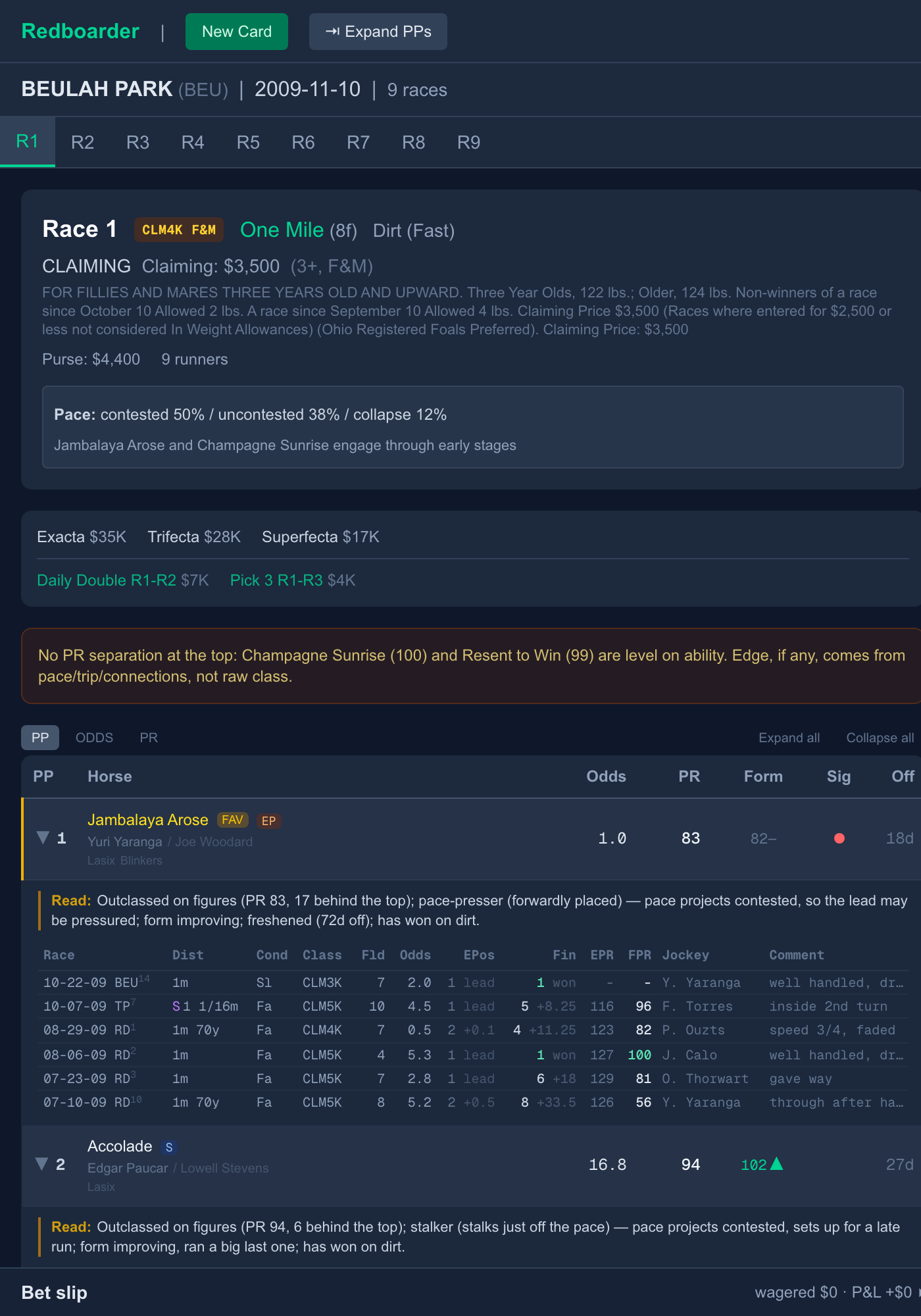
The PP lines expand on demand because past performances are dense; showing everything at once is a wall, showing nothing is useless, so the default is a readable summary that opens into full detail when you want it. Names the AI mentions are clickable and drive the left panel, and the app’s own jargon (PR and the like) carries hover-glossary definitions, because the fastest way to lose a newcomer is a wall of unexplained abbreviations.
Chips: getting past the blank prompt
A chat box has a cold-start problem. A newcomer opens the conversation, sees an empty field, and has no idea what they’re allowed to ask. That blank prompt is where a lot of people quietly give up.
So the conversation seeds itself with chips: tappable suggestions that turn the next move into one tap instead of a sentence you have to compose. They are fast UX for anyone who doesn’t want to type, and a standing answer to “what can I even do here?”, surfacing the questions worth asking at each point in a card. The text box is still there for anyone who’d rather write; the chips just mean you never have to start from nothing.
Betting: a slip and a conversation
You can bet two ways, and that’s deliberate.
There’s a conventional bet slip (tap horses, pick a bet type, set an amount) for people who like to build a ticket by hand. And you can just say it: “put $20 to win on the 7,” “small trifecta box the top three.” The AI turns that into a structured proposal and hands you a one-tap confirm. (The chat path exists because an early tester got shut out at the window with an opinion and no obvious way to act on it from the conversation. The friction was the point.)
Two rules govern the betting, and both are about trust:
- Propose, then confirm, never auto-place. The AI emits a bet structure; you confirm it. That guards against a mis-parse (“the 7” → the wrong horse), keeps a human hand on the (virtual) bankroll, and means an invalid proposal never touches your money: the app hands the reason back and the AI corrects itself.
- The AI never does the arithmetic. It doesn’t compute cost, combinations, payoffs, or whether a bet cashed. A deterministic engine owns all of that and is the single source of truth. This isn’t fussiness. The AI once told a tester, with total confidence, that trifectas couldn’t be played for 50¢ (they can). Language models are for judgement and conversation, not for math you need to be right. So it does the reading, and the engine does the reckoning.
Keeping the results honest
The core promise, that you commit before you’re allowed to know the answer, is enforced in the data, not in a rule the AI is asked to follow.
Each race is split into two files: everything visible beforehand, and a separate file with the finish, payoffs, and replay. The results file can’t be fetched until a commitment token exists for that race, and reveals are hard-gated in order, so you can’t jump to race 8 to see how the day ends. It’s a small state machine, and it’s the reason “no peeking” is a property of the system rather than a promise on the honour system. (How that holds up in a static app that’s really just files on a CDN is its own interesting problem, one for the next post.)
Keeping the AI honest
A conversational partner introduces a failure mode a bet slip never has: it can make things up, and in a practice tool a confident fabrication is worse than useless. So the AI runs under a short list of hard rules, and each one exists because of a specific way it could ruin the experience:
- Never state or invent a result. This is a game about not knowing the outcome; an AI that says “he held on to win” has destroyed the entire point in one sentence. It cannot describe a race in the past tense until the system hands it the official result.
- Never invent a runner. It may only discuss horses present in the data it’s been given: no half-remembered names, no made-up program numbers for a race it hasn’t been shown.
- Never do the betting math (as above); the engine is the source of truth.
- Propose, don’t place: every bet routes through your confirmation.
On top of the persona itself: it speaks in the first person, it treats your opinion as primary, and (the rule I’m most attached to) it holds its own opinions loosely. It’ll state a structural view once, with a reason, and then build whatever you ask for without steamrolling you. A partner that browbeats you into its own ticket is just a tipster with extra steps.
The reveal, and learning from it
Committing is only half the loop; the other half is finding out why.
The reveal shows the finish, the payoffs, and each horse’s actual PR, so you can compare how the field really rated to how you read it.
A separate reflection step then debriefs the race around calibration: not just did you win, but were you right for the right reasons. You can lose a bet on a good decision and win one on a bad one, and a practice tool that only tracks the money teaches you the wrong lesson.
The race replay
The reveal had to be more than a verdict. You commit blind, a read and a bet on the line, and that tension has to pay off with something better than a results page telling you flatly whether you were right. So the centrepiece of the reveal is a race replay: an animated reconstruction from gate to wire, with a live win-probability curve running underneath it and a per-horse trip assessment on top, who got the pace collapse to close into, who was stuck, who was compromised.
The curve is what makes it a moment rather than a scoreboard. You watch your horse loom at the top of the stretch and the line climb toward him, then watch a closer you threw out eat the whole thing up in the final sixteenth. That’s the difference between “you were wrong” and “you were wrong because the pace didn’t fall apart the way you expected,” and the second one is the only feedback that makes you better.
There’s a constraint hiding in here that turned into the best part of it. I don’t have race video, and licensing it is a swamp. So the replay is rendered from the chart data itself, and that turns out to beat video for this: a data-drawn replay can carry the probability curve and the trip notes synced to every call, which footage never could. The thing I couldn’t afford would have been worse than the thing the limitation forced. It stays honest and cheap in the bargain, drawn from the same gated data as everything else.
Why three system prompts, not one
The AI doesn’t run on a single prompt. There are three, scoped to the phases of a session: a short card overview at the start, a full analytical prompt through commitment, and a reflection prompt for the debrief. Splitting them keeps each one focused on the behaviour that phase needs, and it’s cheaper: the overview is precomputed and served as static text with no model call at all, and the analytical prompt stays stable enough to cache.
But the deeper point is that the prompt is where the product philosophy lives. “Partner, not tipster” isn’t a tagline; it’s a rule that says state your view once, then build what the user asks. And “keep it honest” is the rule that forbids inventing a result, not a mission statement. When people ask how you get an AI feature to behave a particular way, the honest answer is that you write down, in exhaustive detail, the things it must never do. Each line is a scar from a time it did.
The thread running through all of it
Read back over these and the same two constraints keep reappearing. Half the decisions serve keeping it honest: the historical races, the pre/post split, the commitment token, the rules against fabrication, the calibration-focused reveal. The other half serve keeping it cheap: precompute everything, my own rating instead of a licensed one, static files, a cached prompt, a rendered replay instead of licensed video.
That’s what falls out of building something real, alone, on a budget: you can’t paper over a bad decision with a bigger team or a bigger bill, so every choice has to earn its place against both masters at once. In the next post I’ll get into how the AI half is built to be convincing, cheap, and hard to fool, including where I went against the grain of how most people wire their own data into a model.
Comments